Only Schwing pumps have the patented ROCK Valve. Here is what it does that other pumps cannot.
It stays balanced under pressure, can be hardfaced and rebuilt, cleans out fully and is easier to service. That means lower wear costs and less downtime.
What the ROCK Valve does
Every concrete pump needs a valve that switches the flow between its two pumping cylinders and the delivery line. That valve works inside wet, abrasive concrete on every stroke, so its design decides how well the pump handles difficult mixes and how much you spend on wear parts.
The ROCK Valve is Schwing's own patented answer. It is a major step on from the older valve design that other brands still use.
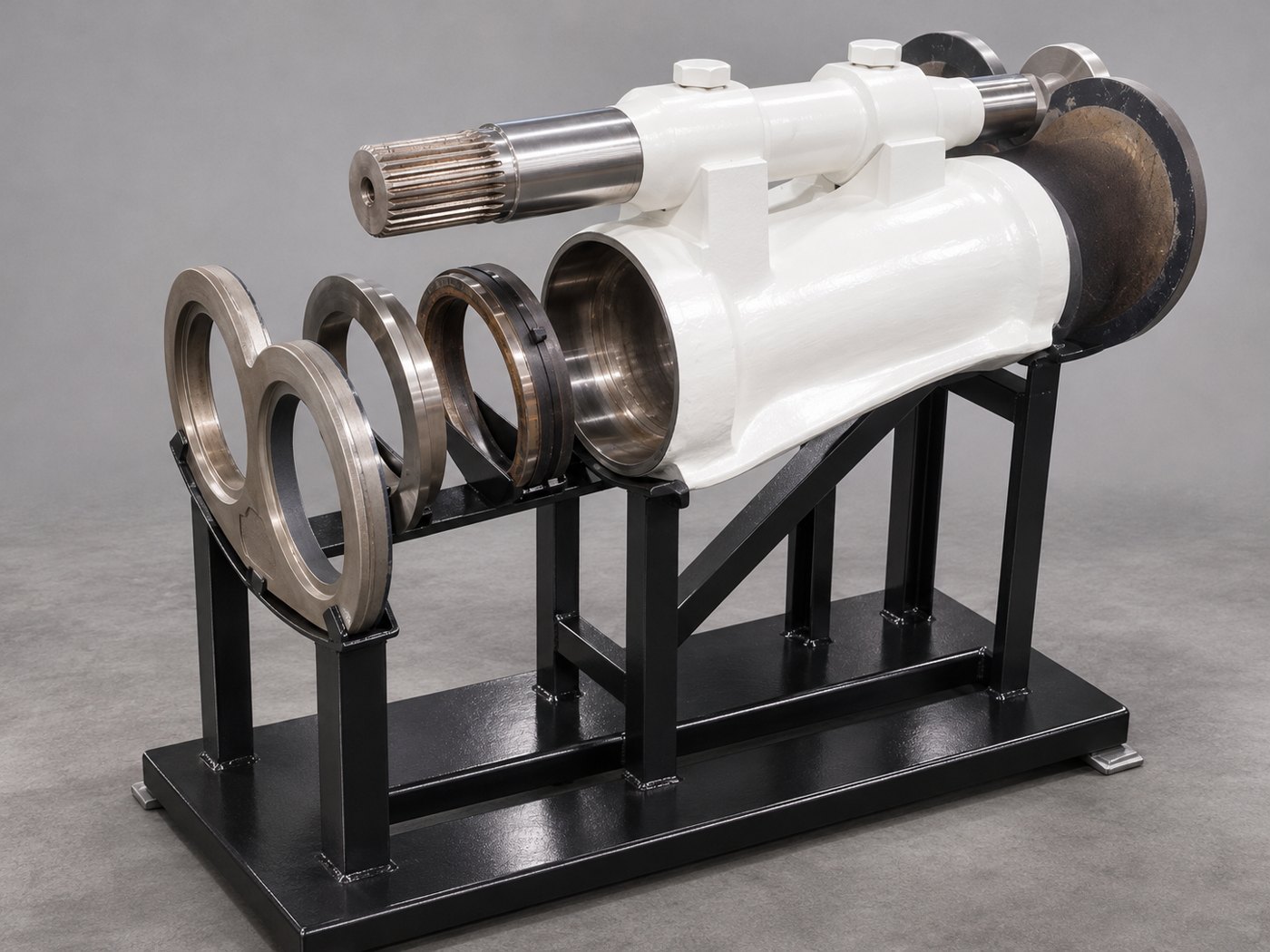
A ROCK Valve assembly with its wear parts laid out in front.
Eight differences you notice in wear costs, cleaning and downtime
This is how Schwing compares the ROCK Valve with the valve fitted to most other brands of pump.
| Other pumps | Schwing ROCK Valve | |
|---|---|---|
| Under pumping pressure | Unbalanced. Pressure tends to lift the valve off its wear plate. | Balanced in its housing. Delivery pressure helps the valve seal. |
| How it is supported | Held by a single shaft support, so loads fall unevenly on the wear parts and bearing. | Carried by a shaft that runs right through the housing, so loads are shared. |
| Hardfacing and rebuilding | The bends and corners of the valve cannot be reached for hardfacing. | Open shape. Every corner can be reached, so it can be hardfaced again and again. Carbide tipping is possible. |
| Cleaning | Hidden zones where leftover concrete stays out of sight. | You can see straight through the valve. |
| Concrete flow | A longer, curved path through the valve. | A wide passage with no restrictions. The outlet is larger than the inlet. |
| Blockages | Prone to plugging inside the valve. | Designed so concrete does not plug inside the valve. |
| What wears | Concrete wears directly on the wear parts. | Concrete wears largely on other concrete. |
| Servicing | More parts to remove, harder to reach. | Fewer moving parts, much easier to service. |
Comparison based on Schwing technical material. Ask us to walk you through it on a machine.
Eight reasons contractors ask for the ROCK Valve
Only in Schwing pumps
Patented by Schwing. You will not find it on another make.
Built to be rebuilt
It can be hardfaced and rebuilt, which the valves on other pumps cannot.
Even wear
The ROCK design wears evenly. The valves on other pumps wear unevenly and need parts replaced more often.
Fewer moving parts
Easier to maintain and less likely to break down.
Smooth pumping
Fewer jerks and less vibration, which extends pipeline life.
Quick to clean and service
A faster turnaround between jobs.
Handles harsh mixes
Suited to local aggregates and low-slump concrete.
Low operating cost
Less downtime, less fuel and less maintenance.
Made for Philippine mixes and Philippine job sites
Concrete mixes in the Philippines are often harsh and job sites are demanding. For contractors and pump rental companies, a valve that is durable, easy to maintain and reliable from pour to pour is a real advantage.
Watch the ROCK Valve at work
ROCK Valve animation
ROCK Valve, front view
ROCK Valve, side view
Standard on our best-selling pump
The RL ROCK Valve is standard equipment on the SP 1200 D stationary pump, and the ROCK Valve is standard on the S 47 SX III boom pump. Ask us which valve is fitted to any other model you are considering.
Pumping a difficult mix?
Tell us about your aggregates, slump and pour volumes, and we will recommend a pump.