A batching plant weighs the ingredients. The mixer is what turns them into concrete, and on a ready-mix plant it has about 30 seconds a batch to do it. Stetter builds two kinds of mixer. Which one your plant carries decides what concrete you can make, and how fast.
Why the mixer matters as much as the scales
Concrete is strong only where every stone and every grain of sand is coated in cement paste. A batch can be weighed to the kilo and still come out with dry pockets, lumps of cement and uneven strength if the mixer does not finish the job.
Both Stetter mixers are compulsory mixers. A drum tumbles the material and waits for gravity to blend it. A compulsory mixer drives its tools through the material and forces it to move. That is why a batching plant can turn out a finished batch in well under a minute.
The pan mixer
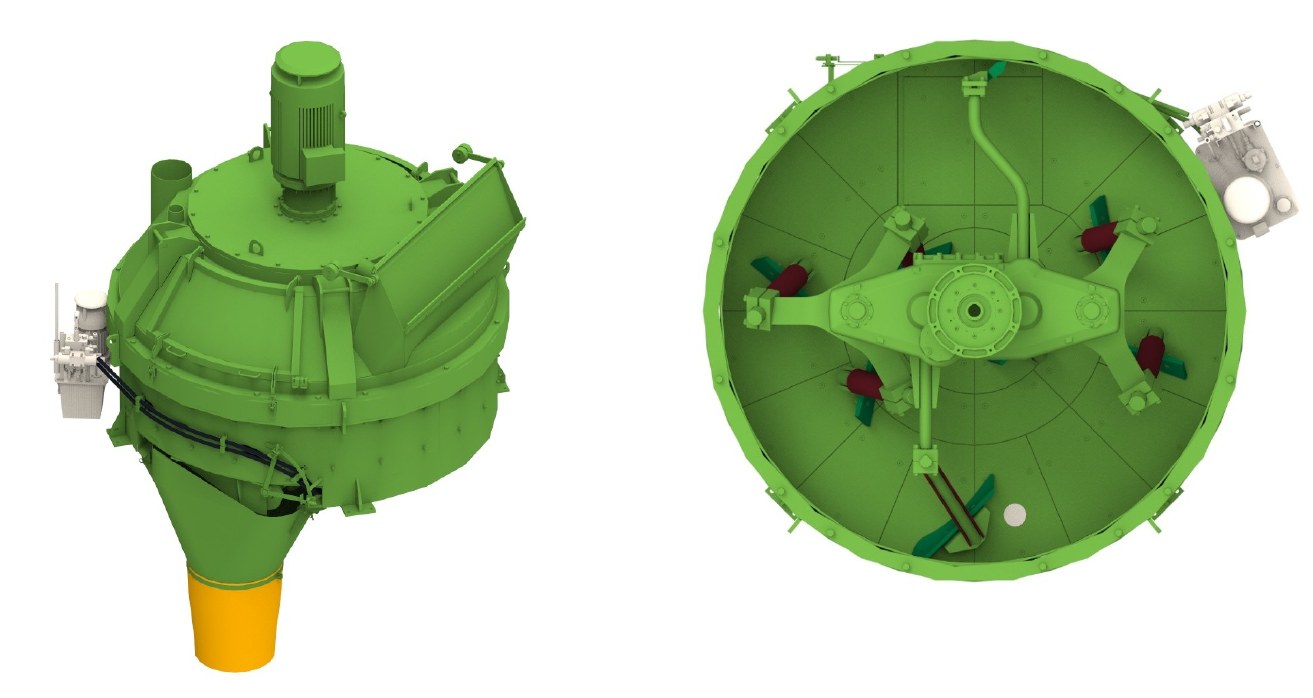
A pan mixer is a round, flat pan with a rotor turning on a vertical shaft in the middle. The rotor carries spring-mounted mixing arms. Scrapers run along the inner and outer walls and push the material back into the path of the arms, so nothing sits still at the edge.
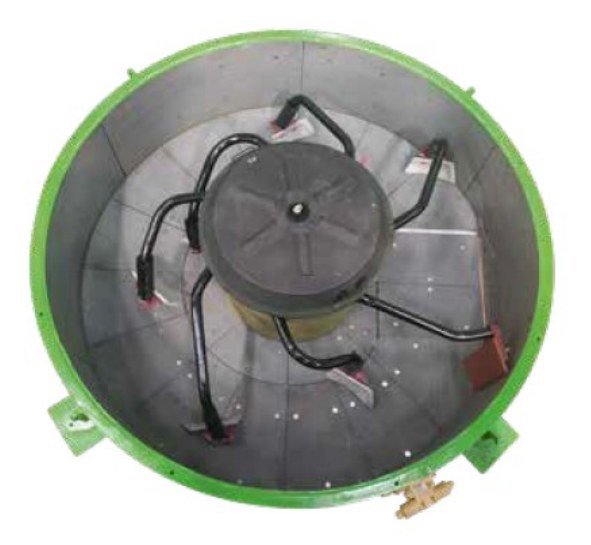
- Intense mixing. The material only has a short way to travel, sideways and up and down, before it is fully blended.
- Short mixing time. Short paths mean the batch is uniform quickly.
- Low energy use. The mixer reaches a uniform batch with little energy put in.
- Accessible components. The pan is open from above. The floor and wall linings can be exchanged, and the wall wear plates can be turned over and used again.
- Quality concrete in every slump range. It handles stiff and flowing mixes alike, and its sliding gates empty the pan completely, so little of the last batch stays behind when you change recipes.
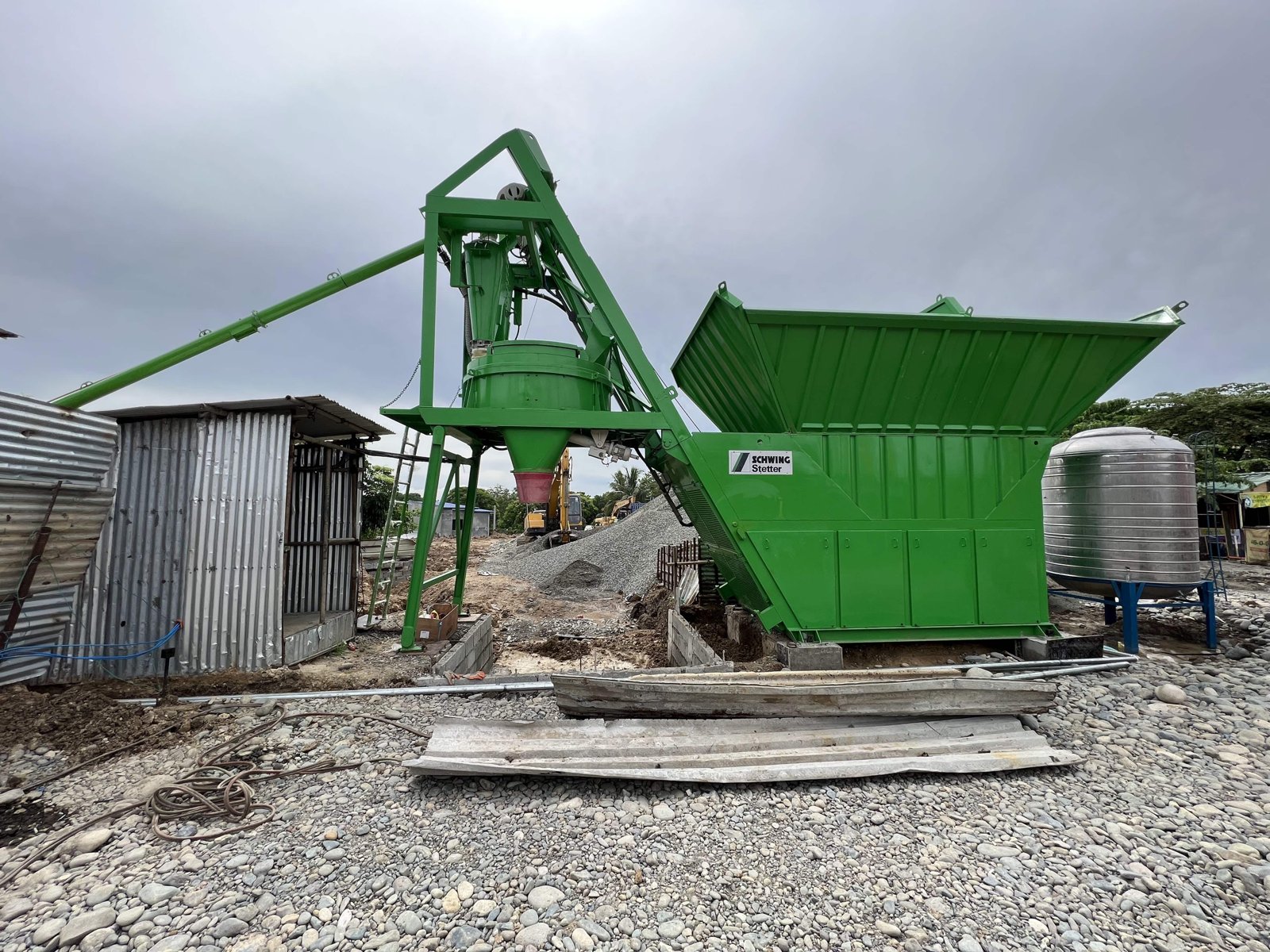
You find pan mixers in the compact and smaller mobile plants: the CP 18, CP 30 and M1. The pan mixers on the CP 18 and CP 30 take aggregate up to 40 mm. On the M1 the limit is 45 mm with the pan mixer and 63 mm with the twin-shaft mixer. The M1 is also built as the M1T, with a twin-shaft mixer in place of the pan. For precast work, the CP 30 can also be supplied with a turbo pan or planetary pan mixer.
The twin-shaft mixer
A twin-shaft mixer is a trough with two horizontal shafts turning in opposite directions. The mixing arms sit on the shafts in a spiral, so the two shafts throw the material toward each other in the middle of the trough while moving it along its length.
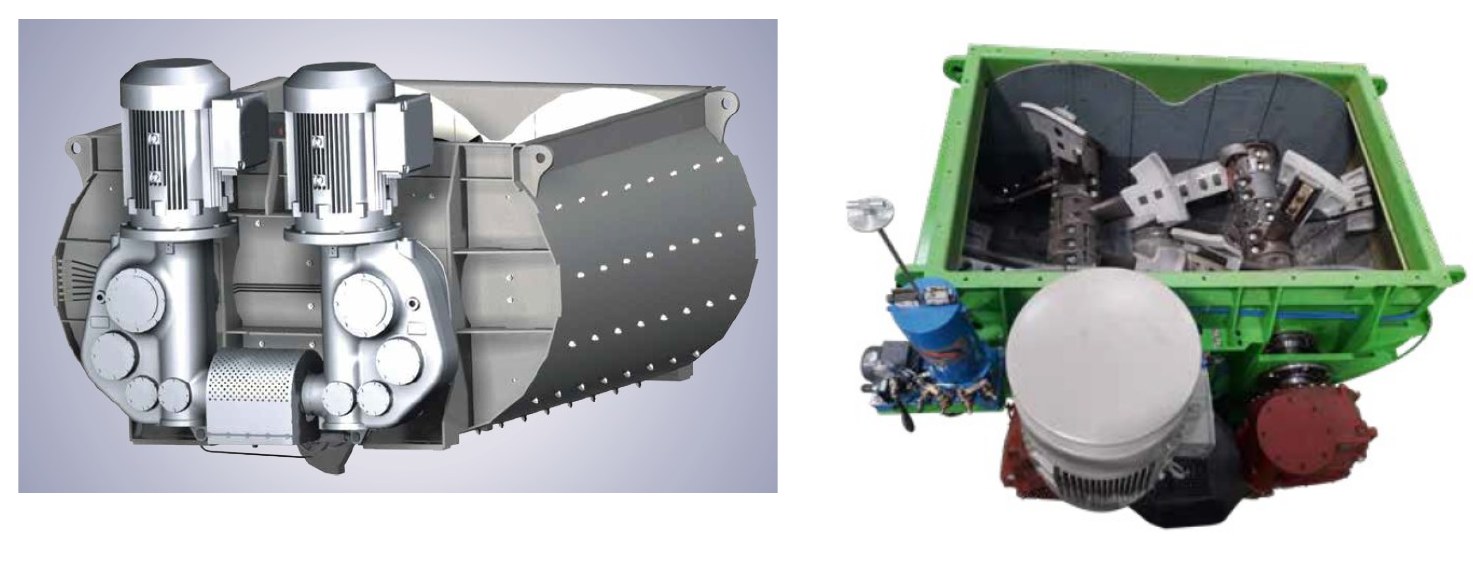
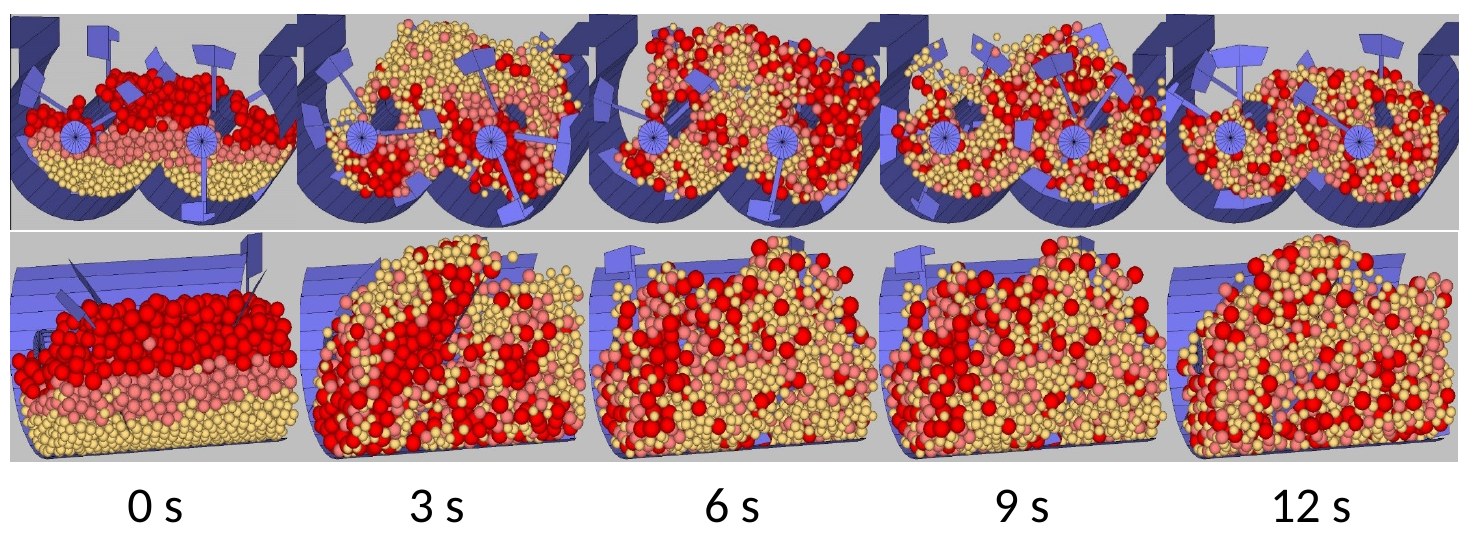
- Thorough mixing at volume. Batches run from 1.25 to 4.0 m³, which is what a ready-mix plant needs to keep trucks moving.
- Wide range of applications. From everyday ready-mix to mass concrete for dams.
- Low wear. The shafts turn slowly, and the trough floor is lined with 20 mm chilled cast iron tiles.
- Very large aggregate. Up to 80 mm as standard on most sizes, and up to 160 mm with the coarse-grain mixing unit.
- Short discharge. A gate running between the two shafts empties the trough fast, and its opening can be set in steps to match what the transit mixer can take.
You find twin-shaft mixers in the larger plants: the T models of the M series such as the M1T, the M 2.5 mobile plant, and the H and HN horizontal plants.
How quickly each mixer blends a batch
Schwing Stetter's training material compares mixer types by how evenly the batch is blended as mixing time goes on.
At 30 seconds the twin-shaft curves are at about 92 to 95%, the pan mixer near 88% and the drum mixer near 72%. Given more time the pan mixer closes most of the gap. The drum mixer does not reach the same level within the time shown, which is the difference between a compulsory mixer and a tumbling drum.
A third type: the planetary mixer
Schwing Stetter also builds a planetary mixer, which its training material lists for precast work. It is a pan with mixing tools that turn on their own axis while they travel around the pan. Schwing Stetter India lists it as an option on the CP 45 in place of the standard pan mixer.
Why most plants we supply have a pan mixer
Buyers often ask why our smaller plants have a pan mixer when many batching plants on the market fit a twin-shaft mixer at every size. Schwing Stetter matches the mixer to the batch size.
- It is the standard at the sizes most contractors buy. Schwing Stetter India builds the CP 18, CP 30 and CP 45 with a pan mixer, offers the M1 with either a pan or a twin-shaft mixer, and fits a twin-shaft mixer from the M 1.25 upward.
- A small batch does not need two shafts. In a pan the material has only a short way to travel before it is blended. The twin-shaft mixer earns its place on volume: large batches, mixed and emptied fast, truck after truck.
- One drive instead of two. A pan mixer has one motor and one gearbox. A twin-shaft mixer has two drives held in step by a coupling, and four shaft seals fed by a central lubrication system.
What each mixer takes to own
We do not publish prices here. The running side can be compared from the manufacturer's own figures. The two columns are for different batch sizes, so read them as the scale of each machine, not as a like-for-like test.
| Pan mixer | Twin-shaft mixer | |
|---|---|---|
| Drive | One motor and one gearbox | Two motors and gear units, joined by a synchronizing coupling |
| Mixer motor | 15 kW on the CP 18, 22 kW on the CP 30, 37 kW on the M1 | 55 kW at 1.25 m³, rising to 2 x 110 kW on the largest plant |
| Gear oil to change | 7 liters on the CP 18, 19 on the CP 30, 38 on the M1 | 70 liters in the worm gear reducers |
| Wear parts | Floor and wall linings, with wall plates that can be turned and used again | Three to four rows of identical floor tiles, and mixing arms replaced one at a time |
Where Schwing Stetter India offers both mixers, as on the M1, ask us to quote both, so you can compare the purchase price alongside the running side.
Side by side
| Pan mixer | Twin-shaft mixer | |
|---|---|---|
| Shape | Round pan, one vertical shaft | Trough, two horizontal shafts |
| Stetter batch sizes | 0.5 to 2.25 m³ | 1.25 to 4.0 m³ |
| Largest aggregate | 40 mm on the CP 18 and CP 30; 45 mm on the M1 | 80 mm, or 160 mm with the coarse-grain unit |
| Discharge | Sliding gates in the pan floor | Gate between the shafts, opening adjustable |
| Strongest at | Smaller batches, frequent recipe changes, precast | High hourly output, ready-mix supply, mass concrete |
| Found in | CP 18, CP 30, M1 | M series T models (such as the M1T), M 2.5, H and HN series |
Which one do you need?
- A project siteBatching for your own pours, up to about 56 m³ an hour: a compact or mobile plant with a pan mixer.
- A ready-mix businessLoading transit mixers all day: a twin-shaft plant, for its batch size and fast discharge.
- Mass concreteDams and heavy foundations with aggregate above 80 mm: a twin-shaft mixer with the coarse-grain unit.
- PrecastStiff mixes and many recipe changes a day: a pan mixer.
Not sure which plant fits your concrete?
Tell us your mix, your aggregate and your hourly volume.