A concrete pump is a hydraulic machine. The engine or electric motor does not push the concrete. It drives hydraulic pumps, and oil under pressure moves the cylinders that do the pushing. A few simple rules explain how it behaves, and why clean, cool oil matters so much to the life of the pump.
How does a hydraulic system work?
A pump pushes oil from a tank into the system. Valves send the oil where it is needed. A cylinder or a hydraulic motor turns the oil pressure back into movement, and the oil returns to the tank to be used again.
Stores the oil. It also cools the oil through its walls, lets trapped air rise out, and gives dirt a place to settle.
Removes dirt by forcing the oil through a fine filter medium. Filters are fitted in the suction line, the pressure line or the return line.
Driven by the engine or electric motor. It pushes oil into the system. It creates flow, not pressure.
Normally closed. It limits the maximum pressure by sending oil back to the tank once the set pressure is reached.
Starts, stops and changes the direction of the oil flow.
Turns oil pressure into straight-line force. On a concrete pump, cylinders like this drive the pistons that push the concrete.
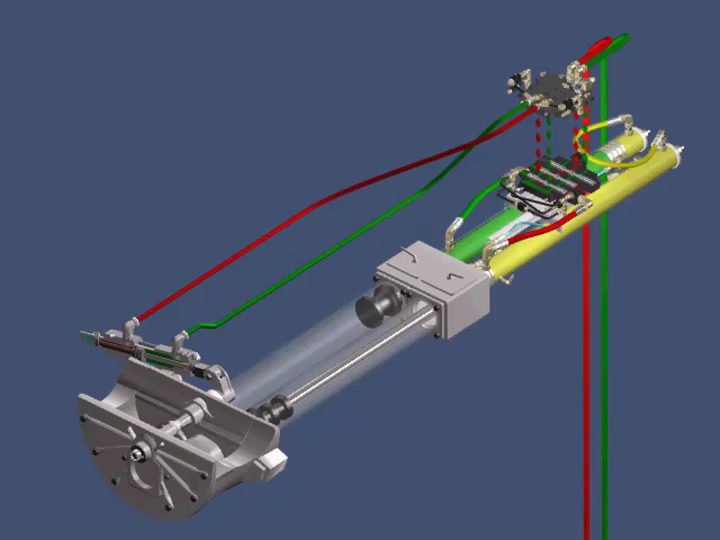
What is the role of the hydraulic oil?
The oil is what carries the force. It can do that because a liquid is almost incompressible: squeeze it and it does not shrink, it pushes back. So when the pump pushes oil in at one end of a line, the same push arrives at the cylinder at the other end. Pressure applied to confined oil is passed on undiminished to every surface the oil touches.
Air is the opposite. It compresses like a spring, which is why air in the oil makes a hydraulic system soft and jerky, and why the tank is built to let trapped air rise out.
The same oil does three more jobs on its way around the circuit:
- It lubricates the pumps, valves and cylinders it passes through.
- It carries heat away to the tank, where the heat is shed.
- It carries dirt away to the filters and to the bottom of the tank.
How does the engine drive the hydraulic pump?
The engine never pushes the concrete directly. Its one job is to turn the hydraulic pump. From there, oil carries the power to the pumping cylinders, the valve and every other function on the machine.
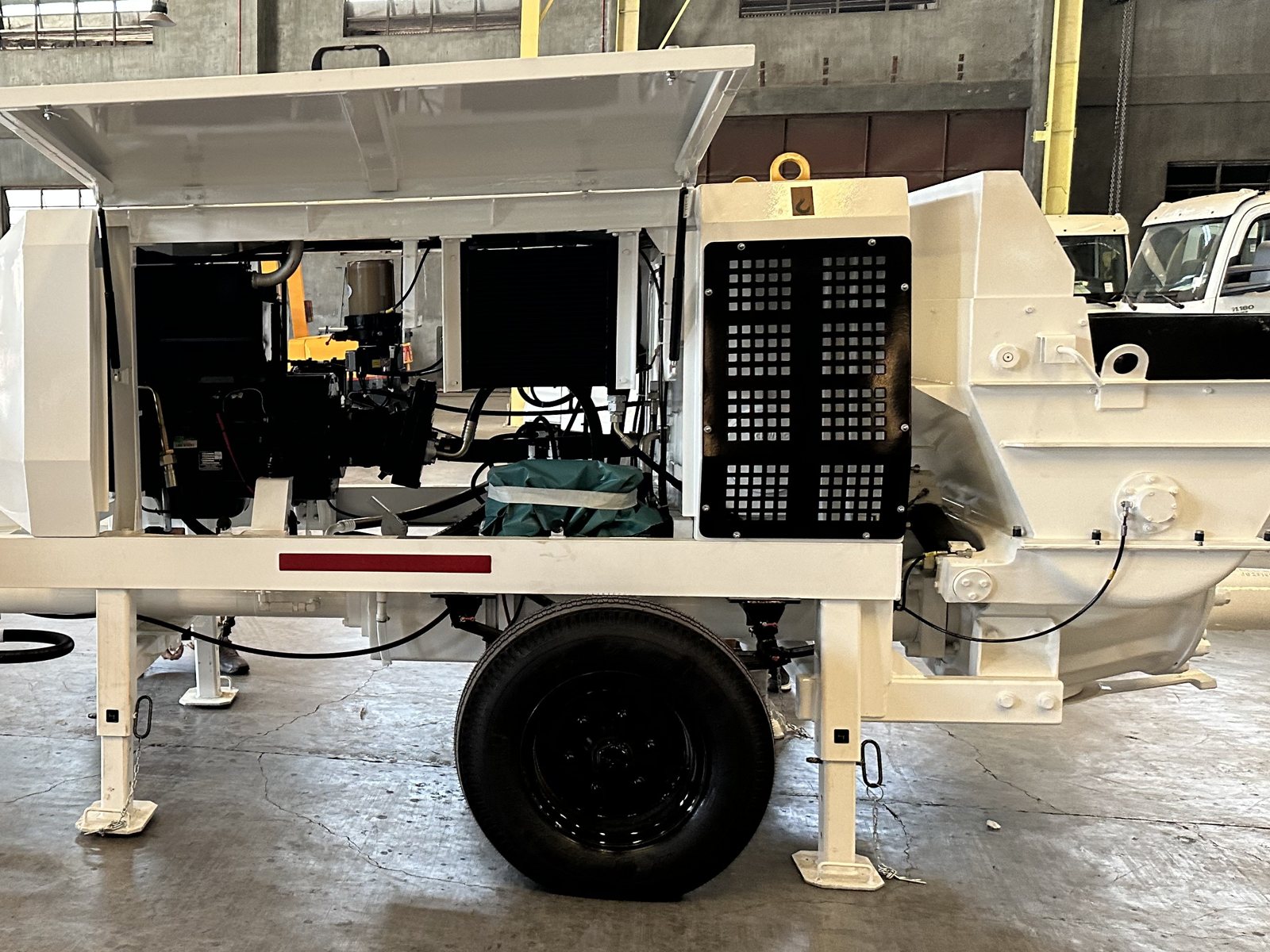
The power travels in a chain:
- The engine turns. A diesel engine or an electric motor supplies the turning power. In hydraulics this is called the prime mover.
- The pump turns with it. The hydraulic pump is coupled to the engine, so it turns whenever the engine does.
- Each turn moves a fixed amount of oil. That amount is the pump's displacement. Turn the pump faster and more oil flows each minute.
- The load creates the pressure. The pump only creates flow. Pressure appears when that flow meets resistance, such as stiff concrete in a long pipeline.
- The oil does the work. Flow gives the pumping cylinders their speed, and pressure gives them their force.
The two sums behind it
| Oil flow (liters per minute) | pump displacement (cc per turn) x engine speed (rpm) / 1,000 |
| Hydraulic power (kW) | pressure (bar) x flow (liters per minute) / 600 |
A worked illustration, not the figures of any particular model: a pump that moves 100 cc per turn, driven at 2,000 rpm, delivers 200 liters of oil per minute. If the job needs 200 bar of oil pressure at that flow, the oil is carrying about 67 kW, and the engine has to supply that plus the losses along the way.
It also explains two things operators notice. Drop the engine speed and the output drops with it, because the pump is turning slower. And an engine that cannot hold its speed under load will show up as a pump that feels weak, even when the hydraulics are in good order.
On truck-mounted equipment
A Stetter truck mixer is driven one of two ways: by a separate engine mounted on the mixer, or by the truck's own engine through a power take-off and a drive shaft.
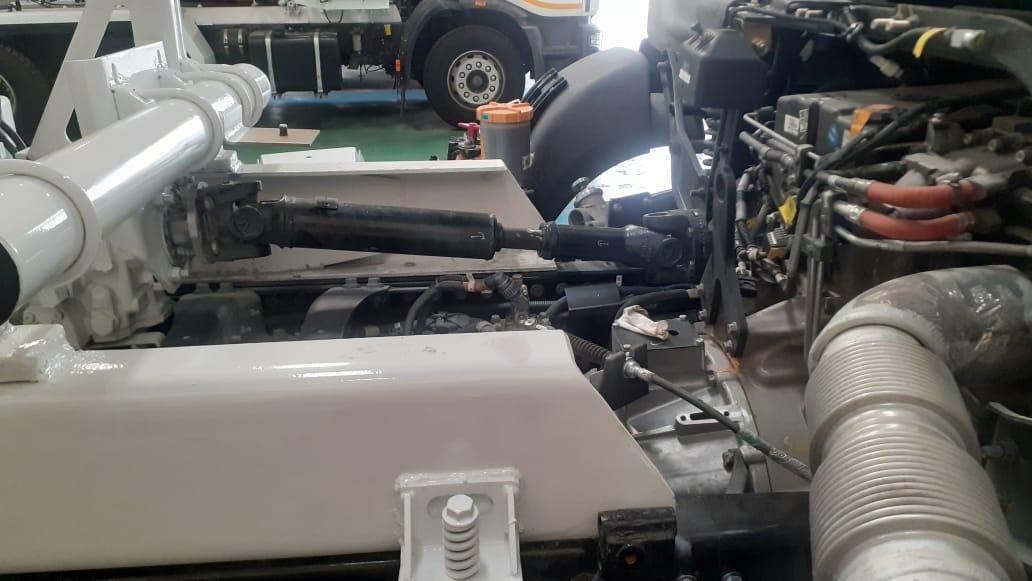
How the hydraulic pump works
The hydraulic pump takes the turning power of the engine or electric motor and turns it into a flow of oil. It does this with pistons, in two strokes.
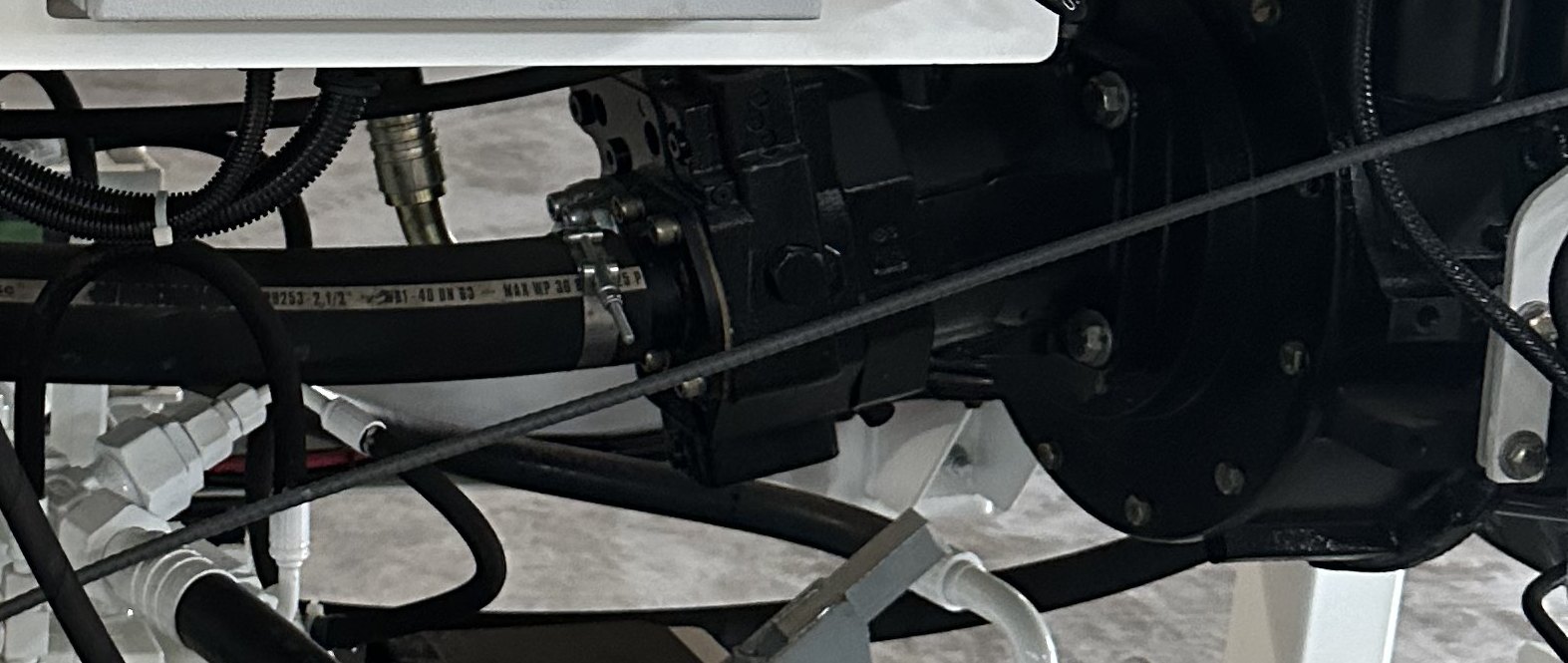
- Suction. A piston pulls back. That creates a partial vacuum, and atmospheric pressure in the tank pushes oil into the pump.
- Delivery. The piston pushes forward and forces that oil out into the system. What goes in is pushed out, stroke after stroke. This is called positive displacement.
The main pumps on a concrete pump are piston pumps. A group of small pistons turns with the shaft and runs against an angled plate. The angle sets how far each piston travels, and so how much oil is delivered on each turn.
On a variable displacement pump the angle can be changed while the pump runs: a small angle gives a little oil, a large angle gives a lot. That is how the concrete output is turned up and down without changing the engine speed. More oil means faster strokes, and more concrete per hour.
Schwing uses pumps that turn in one direction only, at moderate speed. They are physically larger for the same oil flow, and they last longer because they are less highly stressed. Schwing also governs the output, so the hydraulic pump cannot overload the engine or motor.
Common problems
| What you notice | What is usually behind it |
|---|---|
| The pump is noisy, with a whine or a rattle | The pump is not getting enough oil, or is drawing in air: low oil level, a blocked suction line or filter, or a loose suction connection. |
| Strokes are slower than they used to be | The pump is delivering less oil. Worn parts let oil leak back inside the pump. |
| Output drops as the oil warms up | Hot oil is thinner and leaks past worn parts more easily. |
| The oil runs hot | Energy is being turned into heat instead of work: a relief valve opening often, internal leakage, or poor cooling. |
| The oil looks foamy or milky | Air or water in the oil. |
Maintenance: how to look after the hydraulic pump
Nearly every hydraulic pump problem starts with the oil: too little of it, dirt in it, water or air in it, or too much heat. The routine below is built around keeping those four away.
| When | What to do | Why it matters |
|---|---|---|
| Every day, before pumping |
| A pump that runs short of oil, or draws in air or water, damages itself quickly. |
| While pumping |
| Fewer strokes at the same engine speed is an early sign that the pump is delivering less oil. |
| Every week |
| Hot oil is thin oil. It protects less and slips past worn parts more easily. |
| On the schedule in your manual |
| Dirt in the oil is what wears a pump out. |
| Every 1,000 engine hours |
| Wear inside the pump is found by measurement before it stops a pour. |
Write the checks down. A daily log of oil added, temperatures and strokes per minute shows a pump that is slowly losing output long before it fails. The full daily, weekly and hourly lists are in a concrete pump maintenance schedule.
How does the oil push the concrete?
Oil is pumped into a hydraulic cylinder. Because the oil cannot be squeezed, it has only one way to make room: it pushes the piston along. The piston rod is joined to a second piston in the concrete cylinder, and that one pushes the concrete into the delivery line.
The rules that explain most of it
- Oil takes the path of least resistance.
- Pressure acts equally in all directions. Pressure applied to confined oil is passed on undiminished to every surface it touches.
- Oil is almost incompressible. It does not shrink under pressure, so it passes force along instead of absorbing it.
- A pump creates flow, not pressure. Pressure appears only when a load resists the flow. With no load, there is very little pressure at the pump outlet.
- Flow sets speed. More liters per minute, and the cylinder or motor moves faster.
- Pressure sets force. The pressure decides how much force the cylinder puts on its load.
- What is not turned into work turns into heat. Heated oil expands, by 5% or more, and its viscosity changes.
Why does the oil tank matter?
The tank does more than hold oil.
- It cools the oil, passing waste heat out through its walls.
- It lets air that is carried in the oil rise out.
- A baffle plate inside keeps warm returning oil from going straight back to the pump inlet. The oil travels slowly along the tank walls, which sheds heat and lets contaminants settle to the bottom.
- A breather cap lets air in and out as the cylinders extend and retract, through a filter element, generally of 40 micron rating.
- A sight glass shows the oil level.
What do the filters do?
Filters take contaminants out of the oil. A filter has a nominal rating: an element rated 10 microns traps particles of 10 microns and larger.
| Filter | Where it is fitted |
|---|---|
| Suction filter | Between the tank and the pump |
| Pressure filter | After the pump, in a metal housing that withstands the pressure |
| Return filter | In the return line to the tank. A standard part of a hydraulic system. |
Why is one direction of a cylinder stronger and the other faster?
Most hydraulic cylinders are double acting: oil can push the piston either way. But the two sides are not equal, because the rod takes up area on one side.
- Piston side. The oil works on the full piston area. More force, but slower, because more oil is needed to fill the cylinder.
- Rod side. The same flow moves the piston faster, because there is less volume to fill. Less area means less force.
On a concrete pump this is a setting the owner chooses. See rod side or piston side: output or pressure.
What does the pressure relief valve do?
It protects the system from overload. The valve is normally closed. When the pressure reaches its setting, it opens and sends some or all of the pump output back to the tank, so the pressure cannot rise further.
Open circuit: how Schwing pumps keep the oil cool
Schwing concrete pumps use an open hydraulic circuit. The oil returns to the tank on every cycle, where it cools down and where contamination and condensation can settle out. Cooler oil prevents overheating and allows longer pumping hours.
Hydraulics in a self-loading mixer
A self-loading mixer is hydraulic almost throughout. The Stetter self-loading mixer uses both kinds of circuit on one machine.
| Circuit | What the oil moves |
|---|---|
| Open circuit | Steering, the shovel (gate, raise and tilt), the brakes, the drum swivel and raise, and the water pump motor |
| Closed circuit | Travel, and the rotation of the drum |
The same rules apply: flow sets how fast the shovel lifts or the drum turns, and pressure sets how much load it can move. More on the machine in how a self-loading mixer works.
Hydraulics in a batching plant
A batching plant uses far less oil hydraulics than a pump or a self-loading mixer. Its gates and valves are worked mainly by compressed air, and the skip is hauled by a rope.
Where hydraulics does appear is at the mixer. A twin-shaft mixer can have a hydraulically operated discharge gate, and where the mixer has a hydraulic unit, its oil and filter are replaced at the 1,000-hour service. See batching plant maintenance by the hour meter.
What this means for the owner
- Keep the oil clean. Dirt wears pumps, valves and seals. Change filters on schedule.
- Keep the oil at the right level. The tank can only cool and settle the oil it holds.
- Watch the oil temperature. Heat is the sign of pressure and flow doing no useful work.
The intervals are in a concrete pump maintenance schedule.
Common questions
What does the hydraulic pump do on a concrete pump?
It converts the power of the engine or electric motor into a flow of oil. That flow strokes the hydraulic cylinders, so the hydraulic pump sets how much concrete is pumped per hour.
How is the output of a concrete pump adjusted?
By changing how much oil the hydraulic pump delivers. On a variable displacement pump, the angle of an internal plate is changed to deliver more or less oil per turn.
How does hydraulic oil move the pistons of a concrete pump?
Oil pumped into a hydraulic cylinder pushes its piston, because the oil cannot be compressed. The piston rod drives a second piston in the concrete cylinder, which pushes the concrete into the delivery line.
Does a batching plant use hydraulics?
Very little. Most of its gates and valves are worked by compressed air. Some mixers have a hydraulically operated discharge gate.
What does the hydraulic system do on a self-loading mixer?
Almost everything: steering, the loading shovel, the brakes, travel, and the rotation, swivel and raising of the drum.
Why is oil used in a hydraulic system?
Because a liquid is almost incompressible. Oil passes the pump’s force straight to the cylinder instead of absorbing it, and it also lubricates the parts, carries heat to the tank and carries dirt to the filters.
Is hydraulic oil compressible?
Only very slightly. For practical purposes it is treated as incompressible, which is what lets it transmit force.
Does a hydraulic pump create pressure?
No. A pump creates flow. Pressure is created by the load that resists the flow.
What decides how fast a hydraulic cylinder moves?
The flow of oil, in liters per minute. More flow, more speed.
What decides how much force a hydraulic cylinder has?
The pressure of the oil and the area it acts on.
Why does hydraulic oil get hot?
Pressure and flow that are not converted into work are converted into heat.
What kind of hydraulic circuit does a Schwing concrete pump use?
An open circuit. The oil returns to the tank on every cycle to cool and settle.
Questions about your pump’s hydraulics?
Tell us the model and what you are seeing, and our service team will advise.