A generator can carry a batching plant's running load and still struggle when the mixer starts. Before ordering one, confirm your plant's voltage and frequency, its motor starting requirements, and the other equipment that will share the supply.
This guide explains the information your generator supplier needs and the installation decisions to settle with your electrical engineer. It gives published data and manufacturers' guidance. It does not design your installation.
New to the subject? Start with 50 Hz or 60 Hz: what buyers need to know, then return here.
How to choose a generator for your batching plant
A generator is chosen by the generator supplier, from information you provide. These are the six steps, what to ask at each one, and who is responsible for the answer.
Step 1. Confirm what the plant needs
Find the nameplate, the metal plate on the plant's main panel that lists its electrical ratings. Note the voltage, the frequency and that the supply is three-phase, the kind used for industrial motors. Check the same figures in the documents supplied with the plant. The generator must match all three.
Who does it: you, with a clear photo of the nameplate.
Step 2. Get the plant's load information from the equipment supplier
Ask us for three things for your plant and configuration: the verified load, the largest motor (normally the mixer), and how that motor is started. Motor ratings differ between plant models and between versions of the same model, so figures from another plant or an older brochure are not a safe basis.
Who does it: you ask; we confirm.
Step 3. List everything else that will share the generator
Write down every other load on the same set: site lighting, the office and its air conditioning, water pumps, welding sets, a second plant. The generator supplier needs each one, and whether it runs at the same time as the plant.
Who does it: you.
Step 4. Tell the generator supplier how and where it will work
Give the running hours per day, the highest temperature at the site, the altitude, and the fact that the set will stand near cement and aggregate dust. Heat and altitude reduce what an engine and alternator can deliver, and dust affects filtration and cooling. The supplier adjusts the selection for these.
Who does it: you provide the conditions; the generator supplier applies them.
Step 5. Ask for the right rating and a written confirmation
Ask for two things in writing: the duty rating that suits a set running as the plant's main supply, at your site conditions; and confirmation that the proposed set carries the running loads and starts the plant through its actual starting sequence, with the other loads already running, without disturbing the plant's controls. How much voltage dip a plant can ride through is decided by that plant's controls. Ask the supplier what dip it predicts, and send it to us so we can confirm with Schwing Stetter India that the plant accepts it.
Who does it: the generator supplier sizes and confirms. We answer for the plant's side.
Step 6. Confirm installation and commissioning
Before the set is delivered, agree the foundation, position, cable route, protection, grounding and the start-up checks with your electrical engineer, the generator supplier and us. The sections below cover what to plan for.
Who does it: a Professional Electrical Engineer designs and signs the electrical plans. The commissioning team carries out the start-up checks.
Too small or far too large
An undersized set dips or trips on starting, or runs overloaded. A set that is much larger than the work needs costs more to buy and to fuel, and generator makers caution against running an engine lightly loaded for long periods. Ask the supplier what load range the set is meant to work in.
Why the total motor kW is not enough
The motors on a CP 18 add up to about 40 kW, so a 50 kVA generator can look like enough. Schwing Stetter India's reference figure is 75 to 85 kVA. Two things explain the gap. First, kW and kVA are different measures: kW is the working power the motors use, while kVA is the total capacity the generator has to supply, and for motor loads it is the larger number. Second, motors need extra capacity to start.
A motor needs far more current to get moving than to keep turning, in the same way a loaded cart takes a hard shove to start and a light push to keep rolling. While it starts, a motor draws several times its running current. How many times depends on the motor and how it is started.
A strong utility supply may handle that starting demand with little disturbance, though a weak site supply can still see voltage dips. A generator feels it directly: the demand causes a voltage dip, a brief fall in the supply voltage. If the voltage falls further than the plant's controls can ride through, the contactors, the electrically operated switches that turn each motor on and off, let go and the plant stops in the middle of a batch.
- Starting is assessed with the other loads in mind. Ask the supplier to assess the plant's actual starting sequence and the loads already running when the largest motor starts.
- The starting method matters. Some starting methods reduce the starting demand. Which one your plant uses is in its electrical documents.
- The acceptable dip is set by your plant, not by a rule of thumb. Ask the generator supplier what dip it predicts, and send it to us so we can confirm with Schwing Stetter India that the plant accepts it.
Get the load data confirmed for your plant
Motor ratings differ between plant models and between versions of the same model. Before you approach a generator supplier, ask us to confirm the load data for your plant and configuration. The documents supplied with your plant are final.
The published figures are in the technical reference at the end of this guide, for readers who want to see them.
Match the supply to your plant's nameplate
- Voltage. Schwing Stetter India lists 415 V as the operating voltage across its batching plants, with 10% allowed either side.
- Frequency. The Philippine grid runs at 60 Hz. The standard Schwing Stetter India build is 50 Hz, with other frequencies built to order. The CP 18 plants we have supplied recently were built for 60 Hz.
- Three-phase. The supply must be three-phase, with capacity for the plant's connected load.
What to include in your generator inquiry
Put these to the supplier in writing and ask for written answers. The right-hand column says where each point comes from.
| Ask the supplier | What to say | Basis |
|---|---|---|
| Rating class | State that the set is the plant's main supply, and ask for its prime rating at site conditions | A prime rating is a generator rating for supplying ongoing, varying loads under the maker's stated conditions. Makers publish separate emergency standby and prime ratings for the same machine. Emergency standby is for limited hours a year; prime is the class for running in place of the utility. Definitions vary by maker, so ask for theirs. |
| Voltage and frequency | The plant's nameplate values, three-phase | Frequency is fixed by engine speed, and alternators can be connected for several voltages. |
| Motor starting | Give the mixer motor's kW and starting method, the other running loads, and ask for written confirmation that the set starts it without disturbing the plant's controls | The supplier sizes this with its own software and the alternator's data. Ask what voltage dip it predicts. |
| Site conditions | Highest ambient temperature and the dust on a batching plant | Alternators and engines are derated, meaning their available output is reduced, in heat, and makers ask for heavier air cleaning and extra cooling margin in dust. |
| Minimum load | Ask the lowest load the set should run at for long periods | A set that runs lightly loaded for long periods suffers for it. The supplier states the range this set should work in. |
| Average load | Ask what average load the prime rating allows | Makers describe a prime rating with an average load over a day. It is an average, not a ceiling. Ask for the figure for this set. |
| Protection | Main breaker, overcurrent, voltage and frequency protection, ground fault indication | Standard protective functions in generator makers' application guides. |
| Enclosure | Weather or sound-attenuated canopy suited to a coastal, dusty site | One maker specifies aluminum enclosures near salt water. |
An example of generator fuel cost is in our guide to 50 Hz and 60 Hz.
Inquiry checklist to copy
Copy this, fill in the blanks and send it to your generator supplier with the nameplate photo.
GENERATOR INQUIRY FOR A CONCRETE BATCHING PLANT

1. Plant
   Make and model:
   Voltage (from nameplate):
   Frequency (from nameplate):
   Supply: three-phase
   Nameplate photo attached: yes / no

2. Plant load (confirmed by the plant supplier)
   Verified load for this plant and configuration:
   Largest motor (kW) and what it drives:
   Starting method of the largest motor:
   Plant supplier's contact for technical questions:

3. Other equipment on the same generator
   Item / rating / runs at the same time as the plant? (yes or no)
   -
   -

4. Duty and site
   The generator will be the main supply: yes / no
   Running hours per day:
   Highest site temperature:
   Altitude:
   Conditions: cement and aggregate dust; coastal? (yes or no)

5. Please confirm in writing
   a. The rating class your offer is based on, and your definition of it
   b. The set's rated output at our site conditions
   c. That the set carries the running loads listed above
   d. That the set starts the plant through its actual starting sequence,
      with the other loads running, without disturbing the plant's controls,
      and the voltage dip you predict
   e. The load range the set is intended to work in
   f. Protection fitted, enclosure type and air filtration for a dusty site
   g. Installation requirements: foundation, clearances, airflow, exhaust
   h. What your technician does at commissioning
Plan airflow, access and cable routing before installation
The dimensions for your set are in its installation manual, and that manual governs. These are the points to plan for, with examples from makers' published guidance.
| Plan for | What makers ask for |
|---|---|
| A foundation | A level, reinforced concrete pad larger than the set's base and raised above the ground. Cummins's guidance, for example, gives a pad at least 150 mm thick, 150 mm beyond the base and 150 mm above the floor. |
| No standing water | Makers say not to install where flooding is possible. |
| Service space | Clear space on every side. Published figures run from about 1 m to 1.5 m, with room for the canopy doors to open fully. |
| Airflow | Hot discharge air must not be drawn back into the intake, and the discharge end should not face the prevailing wind or a nearby wall. |
| Exhaust | Away from the operator's cabin, openings and air intakes, clear of anything combustible, with rain kept out of the outlet. |
| Vibration | Flexible sections where the fuel line, exhaust and cable meet the set. |
| Noise | As an example, Cummins lists a 100 kW set at about 86 dB(A) at 7 m in a weather canopy and 70 to 77 in sound-attenuated canopies. |
| Cable route | A position close to the plant's main panel keeps the cable short and the voltage drop low. |
Two further points are our own site advice: keep the set out of the dust from silo filling and aggregate loading, and out of the path of trucks and the wheel loader. We could not confirm a specific Philippine rule on generator setbacks or on-site diesel storage, so check both with your local Bureau of Fire Protection before the pad is poured.
Settle the wiring with your electrical engineer
Who designs it
In the Philippines, electrical plans are signed and sealed by a Professional Electrical Engineer. The installation needs an electrical permit, and occupational safety rules require approved plans before work starts and inspection before it is energized. Bring the engineer in before the plant arrives.
The incoming cable
The manufacturer's documents list incomer cable sizes, for example 4 x 25 sq mm copper for the CP 18 and CP 30, 4 x 50 sq mm for the M1 and 4 x 150 sq mm for the H3N. Treat these as the manufacturer's reference, not as a design. The right size has to be calculated for your installation from four things:
- the actual load and its starting current
- the length of the route
- how the cable is installed: in air, in conduit, buried, or bundled with others
- the temperature it will run in
The engineer checks the result against current-carrying capacity and against voltage drop, under the Philippine Electrical Code.
Grounding
- Ground the whole plant: frames, silos, the control cabin and the generator, bonded into one grounding system.
- Schwing Stetter's training material asks for double grounding on the electrical equipment.
- Where the neutral is connected to ground depends on whether the transfer equipment switches the neutral and whether the generator counts as a separate source. This is a design decision for the engineer (Cummins transfer switch application manual).
- Electrode resistance, conductor sizes and silo lightning protection are set by the engineer under the Philippine Electrical Code.
Grid and generator together
A site with both needs transfer equipment that connects one source at a time and cannot join the two. A generator that feeds back into the utility line endangers the people working on it and can wreck the generator when grid power returns.
What to confirm before the plant starts operating
Ask the installation and commissioning team to confirm that the supply matches the plant's electrical ratings, that each motor runs in the correct direction, and that the supply remains suitable when the plant starts.
The team should also test the emergency stops and other safety devices under the approved commissioning procedure. Electrical measurements and adjustments belong to qualified personnel.
Keep the commissioning record with the plant's operating and maintenance documents.
What the motors do
For readers who want the detail behind the load figures. Every motor on the plant is a three-phase induction motor: the supply creates a rotating magnetic field, and the field drags the rotor around with it. Its speed is set by the supply frequency. Each motor has one job in the batch. The ratings shown come from a 2004 CP 18 manual and apply to that configuration; a current unit may differ.
| Motor | What it does | CP 18 rating in the 2004 manual |
|---|---|---|
| Mixer | Turns the mixing arms through the whole batch. The largest motor on the plant, and the one that may have to start under load. | 15 kW |
| Skip | Winches the weighed aggregates up the track and tips them into the mixer. | 8 kW |
| Cement screw conveyor | Carries cement from the silo or feeding hopper to the cement scale. | 7.5 kW |
| Water pump | Delivers batching water to the water scale. This pump is supplied by the customer. | 3.7 kW |
| Compressor | Supplies the air that opens the aggregate gates and works the valves. | 1.5 kW |
| Mixer gate | Opens and closes the mixer discharge. | 1.5 kW |
| Admixture dosing pump | Meters admixture into the batch. | 0.75 kW |
| Sand vibrator | Shakes the sand bin so damp sand keeps flowing. | 0.18 kW |
Larger plants do the same jobs with bigger or additional motors. A twin-shaft mixer is driven by two motors. Plants with in-line silos replace the skip with a weighing belt and an inclined conveyor, and each cement silo adds its own screw.
The protection built into the plant
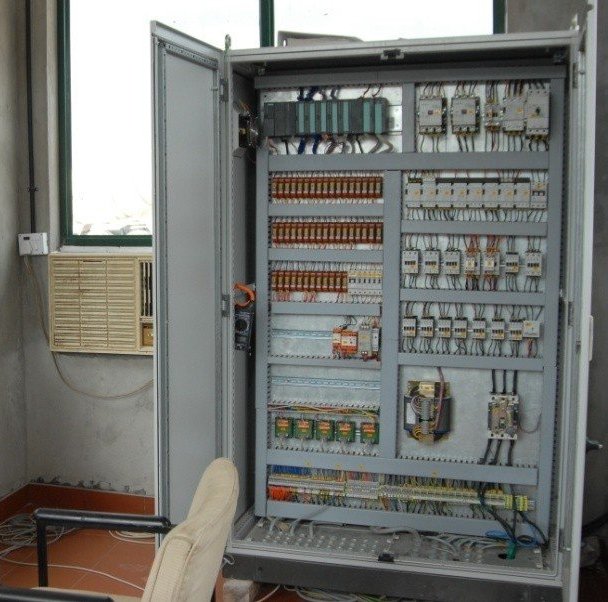
- Emergency stops in the operator's cabin and near the skip channel.
- Limit switches at the top of the skip travel and on the mixer cover.
- The main breaker and its undervoltage coil, which trips the main supply when a safety device is triggered.
- Motor protection breakers for the individual motors, and a phase failure relay.
Schwing Stetter's safety training asks that none of these be bypassed and that a contactor be replaced with one of the same capacity. Maintenance work on the structure, welding included, follows the approved maintenance procedure and is done by trained personnel. The full list is in batching plant safety.
Technical reference: published generator figures by plant
These are reference figures from Schwing Stetter India for the standard 50 Hz build. Where two figures are shown, the right one depends on the plant's configuration, and we confirm it for your plant.
| Plant | Mixer drive | Motor load | Reference generator size |
|---|---|---|---|
| CP 18 | 15 kW | About 38 to 41 kW | 75 or 85 kVA |
| CP 30 | 22 kW | About 54 kW | 83 or 100 kVA |
| M1 | 37 kW | About 82 kW | 125 or 180 kVA |
| H 1.25 | 55 kW | About 144 kW | 250 kVA |
| H2N | 75 kW | About 225 kW | 350 kVA |
| H3N | 2 x 50 kW | About 220 to 260 kW | 350 or 400 kVA |
| H4N | 2 x 75 kW | About 315 to 350 kW | 500 kVA |
| H6N | 2 x 110 kW | About 420 kW | 750 kVA |
Every figure is for the plant alone. Other site loads need capacity on top.
Alternator excitation. For motor starting, alternator makers recommend permanent magnet or auxiliary winding excitation over the basic self-excited type. Your generator supplier may raise this, and it is a fair question to ask.
Sources
- Schwing Stetter India: plant electrical data, operating manual, specification sheets and training material.
- Cummins: motor starting on generator sets.
- Cummins: transfer switch application manual.
- Generator and alternator makers' published application and installation guides for rating classes, excitation, derating, minimum load and installation.
Planning power for a new plant, or checking an existing setup?
Send us your plant model, a clear nameplate photo, your available supply details, and any generator quotation you are considering. Include other equipment that will share the supply so we can discuss your requirements.